
Lighting
Electric lighting, on average accounts for about 15% of residential electric usage, but that number varies with both user behavior and lighting efficiency. The rule of thumb is to use efficient lighting everywhere, but the energy conscious person will find that changing as little as 25% of bulbs to efficient lighting will achieve 90% or more of the possible savings, because only a handful of bulbs are on for any length of time. Occupancy sensors can reduce lighting energy, but can be extremely annoying, and for the energy conscious, will not result in any savings.1
Lighting has come a long way in the last twenty years or so, and there are now a number of high efficiency bulbs, and CFLs are now also much better. Unfortunately this new era of choice, means your now faced with buying bulbs labeled not just in watts drawn, but with their CRI (color rendering index) and color temperature, and lumens. Plus you need to know whether it is dimmable or not dimmable.
Daylighting
It is not that common to have to use electric light in houses during the day, but it is still more common than it should be. If the site is dark for some reason, you usually have to live with it, although when the reason is trees, most people prune them back quite a bit.
Because houses are small buildings, getting daylight in every room is generally easy, especially since even north windows on a somewhat cloudy day let in much more light than a 100W bulb generates. In spite of that a huge number of buildings have daylighting problems in at least one area of the house.
Not every room needs the same amount of light, and in general the more public spaces tend to want more light, while private spaces like bedrooms need less light. Lighter colored walls reflect much more light than darker ones, and so also create a more dispersed light.
There are two basic rules of thumb in daylighting: the light-depth rule, and the light-on-two sides rule. For how building shape affects daylight, see the shape rule in design.
Light-depth: there is a limit to how far light will penetrate a room before it starts getting dark, and that limit is somewhere between 2 and 2.5 times the height of the top of the window (the range is because its depends on how bright "bright enough" is). So for windows that are the standard 80" off the floor, that's 160" to 200", or about 13' to 16'. By using a taller wall (say 9') and installing transom windows, you can bump that distance out by another 3' or so, but this adds expense and with it most likely, an energy penalty. Obviously the further you are from the windows the darker it will be, and even for a room only 13' wide, the difference in amount of light from near the windows to the far wall is great, leading to potential eye strain, particularly when looking at the bright windows from the darker part of the room. However this can be mitigated somewhat, which leads to the second rule of thumb.
Light-on-two-sides: the light in a room is much more even if it comes from at least two direction, particularly when the walls are lighter in color: the light will now bounce around the room more and create a more even lighting. Bathrooms almost universally violate this rule, and hence you often need to turn on an electric light to see both sides of your face in the mirror. For a room bounded by other rooms (ie light on one side), there are three general solutions, and a third more complex one.
First, you can eliminate the interior walls, for example in building a great room instead of separate kitchen/dining/living rooms. The lesser version of this would be to put ample glass in the interior wall so that the light will shine thru.
Second, you can bump the room out so that it sticks out from the main body of the house a bit. Often this is only about 2' (eg a bay window), but how effective this is isn't clear. Bumping out further, to say 1/3 the room depth will clearly help much more.4
Third, is to use a skylight or solatube, although skylights should be used with caution due to the potential of excess solar gain (see passive solar section for details). This is obviously quite difficult or impossible if there is another room above this one.
Finally, if you opt for taller walls and transom windows you can use a light shelf between the main windows and the transom, so that the light coming from the transom is bounced off the ceiling.
Electric Lighting
The remaining part of this discussion pertains only to electric lighting.
Lighting Terminology
New labeling laws are requiring bulbs to be labels with the following characteristics, so although it makes picking more complex, at least you will now know what you're getting.
Lumens - a measure of the light output. This is not the same as wattage, which is the amount of electric the bulb takes to produce its light.
Wattage - the power the bulb draws. This translates directly into your power bill, not necessarily into the amount of light.
Efficacy - a measure of the efficiency the bulb produces light, as lumen per watt. An incandescent would generally be under 20 lumens/watt and a fluorescent over 60.
Color temperature - a measure of how skewed the light is toward one or the other color in the spectrum. Technically, its the temperature a "standard black body" would have to be to put out a light spectrum that is similar to what the bulb puts out, and it measured in degrees Kelvin. While this sounds very technical, the key is that sunlight is essentially a black body and so is an incandescent bulb. Incandescents are 2700k, while daylight is about 6000K. They both emit a wide range of wavelengths of radiation, but with the peak of the curve in different places.
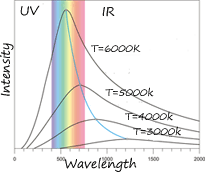 Image courtesy Eni Generalic, periodni.com
The image at right shows this: the bottom curve is the incandescent blub where most of the energy comes out as heat (the infrared spectrum) and there is almost no blue, while the top curve is for sunlight, where much of the energy is in the visible range, and the blue and red light amount are fairly balanced. Note that the height of these curves is misleading, because in a light bulb other factors control how much light comes out. What is important is the shape of the curve, and where the relative amount of each color are.
What color temperature tells is what the relative amounts of each color there are, meaning that a 6000K bulb has a similar ratio of color distribution to daylight and a 2700K bulb has a similar distribution to an incandescent bulb.
Many people like the warm feel of 2700K bulbs.
Color Rendering Index (CRI) - is a value from 1 to 100, and is a score of how well a set of eight standard colors appear under the light. A score of 100 means the colors appear exactly as they do under a standard incandescent bulb (the is by definition), and any score above 80 is good. Where color temperature tells about the relative amounts of each color coming from the bulb, CRI tells whether all the wavelengths are there and to some degree if the shape of the light emission curve looks like. A 2700k CFL with a CRI of less than 80 for example, likely has a curve that looks like three bumps with big valleys in between, meaning that for some colors on the spectrum it emits almost no light. This is because a CFL is not a blackbody: it uses different color phosphors that emit light in a narrow range.
A poor CRI is often the reason a bulb makes everything ugly, even if its "warm", or supposedly 2700K. The only way to tell is to look at the CRI value. Note that a standard incandescent bulb is very yellow-orange compared to daylight, so for example if you wanted your wall paint to look the same at night as it does during the day, you'll want a bulb with both a CRI of 100 and a color temperature above 5000K.
Beam spread - a measure of how wide the light is distributed. Standard incandescents are generally very wide, but other bulbs may not be. Bulbs may be spot or flood, with flood sometimes subdivided in how wide.
Types of bulbs
Incandescent types: these are all variations on Edison's original bulb, using a filament heated to a very high temperature in a glass bulb with the oxygen removed. They run directly on the standard 120VAC electric.
Running an incandescent on a dimmer not only saves power, but extends the lifetime. Just dimming 10% can double the lifetime, and 20% will quadruple it. The caveat, is that turning the bulb on and off causes heat stress, and ultimately failure.
Incandescent - most everyone likes the look of them, but they use a lot of power: they convert only 5-10% of the power consumed into light. In summer, that excess power turns into heat that the air conditioning system must then remove. The major advantage of them is that they're simple, cheap, dimmable, and have a relatively low environmental impact. They're being slowly phased out which is somewhat unfortunately since they're cheap and have a lower embodied energy than the alternatives.
Halogen - these are improved incandescent lights that are slightly more efficient, and produce a whiter light. Instead of having the filament in a semi-vacuum, the filament is in a halogen gas. They burn hotter, also last longer than standard incandescent lights.
Halogen IR - these are up to 30% more efficient than standard incandescents. The tricks is that the quartz capsule that holds the halogen has a special coating that reflects infrared (IR) back to the filament, allowing it to operate at the necessary temperature using less power. Because these are more efficient, you buy them by the lumens needed, not watts used.
Fluorescent types - there are two general types: hot cathode and cold cathode. In either case, current flows thru the bulb, exciting atoms of mercury vapor, which in turn emit UV light, which in turn hits the phosphor coatings on the glass to emit visible light. In the hot cathode type, electrons are release by the heat, in cold cathode is its a combination of heat and voltage. The cold cathode versions are longer lasting, but generally less efficient and used only is special applications, like exit signs and LCD backlights. While old bulbs used a single phosphor that produced a very greenish light, new ones use multiple phosphors. The color temperature and CRI are dependent on what mix of phosphors are used. Newer CFLs use a much better mix than older ones.
Fluorescent bulbs require a ballast, which is a circuit used to operate them. This circuit must "start" the bulb, which is to get the initial flow of electrons going off the cathode, and then maintain the proper flow. In a cold cathode bulb, a high voltage is also needed. Older bulbs used magnetic ballasts that often hummed, buzzed and produced a flickering light, while newer ones use electronic ballasts that have none of these problems. There is, however, often a delay of 1-2 minutes before the bulb reaches full brightness, which is the time it takes to fully heat the cathode up.
Fluorescents generally last much longer than incandescents, anywhere from 5 to 30 times longer, although turning it on and off frequently will shorten its lifespan (as it will to incandescents as well). Although they are still more expensive per bulb than incandescents, they are cheap enough (especially when you buy a six-pack), that their lifetime cost (including the electric used) is usually much cheaper than a standard incandescent. They use only 1/4 to 1/3 of the power as an incandescent.
The problem with dimming fluorescents has to do with the interaction of the dimmer and the ballast, and most standard dimmers don't work with most ballasts. Even when they do work, don't expect to get the range of dimming available to an incandescent because at lower power levels, it becomes impossible to maintain the current flow to ionize the mercury atoms, and so the lamp turns off.
Because fluorescents contain a small amount of mercury in the bulb, and CFLs additionally have electronics in the base, disposal is a serious concern. In some communities CFLs are considered hazardous waste, and must be disposed of specially, but most allow then in the trash. It is the major environmental argument against fluorescents.
Linear fluorescent - these come in various lengths, typically 2, 4, or 6 feet, and in various thickness' also, with typical sizes being T12, T8, and T5, where the number is in eights of an inch (so a T8 is 1"). Unlike CFLs, in linear fluorescents, the ballast is part of the fixture, and it is this ballast that largely determines the efficiency of the lamp.
Compact fluorescent (CFL) - there come in various shapes, although the "twister" bulbs have become the standard for residential usage. A CFL contains both a lamp and a ballast in one package. At one point pin-type CFL (as compared to the standard screw base) were meant to be used in fixtures with built-in ballasts, but the newer GU24 pin type CFL are exactly the same as the screw base, except you can't ever put an incandescent in the fixture.2 LEDs are starting to replace CFLs.
Light Emitted Diodes (LEDs) - are solid state devices similar to transistors and computer chips that use low voltage direct current (ie nothing like the 120VAC that the power company provides)3 to produce light. Like fluorescents, they require a power supply (a variation on the little black wall warts used to charge various electronic devices). Unfortunately the mechanism that produces light in an LED, produces monochromatic lights (one color) in an extremely narrow frequency range, so to get white light, either multiple color LEDs must be mixed, or phosphors put on the LED that convert the monochromatic light to white light. Although the phosphor method is less efficient in principle, it is the most common method in use. In this system, the efficiency of the bulb is a combination of the efficiency of the power supply, the LED itself, and the phosphor conversion.
LED promise very high efficacies (twice CFLs), but many of the currently available products are less efficient than CFLs although as of 2013 that is changing rapidly. Currently, the main advantage is that they're dimmable and more efficient than Halogen-IR bulbs.
LEDs are very sensitive to heat, and burn out easily from heat, so they are usually mounted in big heat sinks. Care must be taken in where they mounted, so that heat can dissipate.
The price of LEDs has dropped dramatically since 2015: you can get them for far less than $10 each now. They promise extremely long lifetimes (30-50,000 hours, compare to 1000 for an incandescent, or 10,000 for a CFL) and unlike CFLs are less likely to burn out early.
LEDs are dimmable only if they say so, and only by special wall dimmers--well they may work with many dimmers or they may not. Older dimmers worked by turning the power off for part of each of the 60 cycles, and since LEDs turn on and off fast, that's not a problem, but the power supply to the LED (which run at around 5 volts DC), might not like it. Best to use a dimmer model the LED manufacturer says is compatible.
In general the "cool" color LEDs (ie in the 6000K range) are more efficient then the warm color ones (ie in the 2700K range), but I found a 2700K bulb at 94lumens/watt, which is pretty decent, so this might not be a concern. Best to check the lumens/watt and make sure its at least 60. Its worth looking at the CRI value also: anything less than 80 might make colors in the room look weird.
Lighting Design
There are two primary kinds of light fixtures, ambient lighting and task lighting. Ambient lighting is for walking around in the room and doing anything that doesn't necessarily involve seeing in great detail. Task lighting is a spot lighting, providing a localized brighter light for tasks like reading which require more light. In homes, traditionally ambient lighting is bright enough to read by, which obviously uses more power than necessary. Every room will require ambient lighting (unless you want to walk in the dark!), but only a very few areas will require task lighting: for example, kitchens, offices, a living room chair, or a bedside table.
Ambient lights generally need flood type widespread bulbs, while task lighting may be either flood or spot, depending on whether ambient light is also present.
What bulb to use? Many lights in the house are rarely on, and so using more expensive high efficiency lights will not result in measurable energy savings. It is often the case that only a small handful of lights in the house are on for any length of time, and so those are the prime candidates for high-efficiency bulbs. Because CFLs are now so cheap, fixtures receiving a medium amount of use can profitably be changed to CFLs. For the environmentalist who leaves only a minimum amount of lighting, the mercury added to the environment may not be worth the small incremental savings of a CFL that is only on 20 minutes a day in the winter. LEDs are now becoming cheap enough to use everywhere, and they might last long enough to make their additional embodied energy worth it...I haven't seen any studies yet.
The best way to save energy is to just turn the light off when you're done with it--done meaning you have no current intention of returning to the room, or the likely return is long enough off (say 10 minutes). If you want to leave lights on for the evening, then 13 to 15W CFLs (or even lower wattage LEDs if you can find an efficient one) are the best choice.
Light fixture amount - not only have houses grown in size and number of electronic gadgets, but the number of light fixtures (in particular can lighting) has also gone up, in my view totally unnecessarily.
Recessed downlights (can lights): although they're relatively cheap and hidden in the ceiling, these are not the best way to light a room, because of the inherently narrow beam.
Energy Star labeling - energy star bulbs are not only the more efficient ones, but also have a CRI of at least 80, so will produce decent light.
Resources
patternguide.advancedbuildings.net/home - daylighting guide (The focus is on commercial buildings, but the ideas are the same).
www.energysavers.gov - US DOE lighting info
Seattle lighting Guide From the city's green building program
Seattle City Light's energy efficient lighting website
http://www.americanlightingassoc.com/info_lighting.php American Lung Assn. lighting guide
www.cee1.org Consortium for Energy Efficiency (CEE) lighting info
Notes
1: Occupancy sensors are intended mostly for commercial settings, or in residential uses, they are to cover up for the dumb and lazy, and in those cases they save energy. If you're good about turning lights out, occupancy sensors will cost you a bunch of money ($20-$40 ea) and will buy you nothing. They also might end up causing you to use more energy and/or have bulbs burn out early due to excessive cycling. Nowhere could I find how much phantom load they create, apparently quite small, but if the world goes the way of California Title 24, I imagine 100 million of these things, and that adds up to real power, just because people don't turn out the lights.
2: in my not so humble opinion this is a really stupid idea, driven by California Title 24 with the intention of prohibiting people from replacing the CFLs with standard bulbs. At the moment, it also keeps you from screwing more efficient LEDs in there. And, of course the intrepid rip the fixture out and sent it to the landfill anyhow, or simple buy pole/table lamps and put their beloved incandescents in them.
3: old style low output LEDs were generally 5VDC, and the new white LEDs in flashlights clearly run on the similar battery voltage, but I was unable to find the typical voltage of the high-output white LEDs used as light bulb replacements.
4: the pattern (#159 "light on two sides") in Alexander, et al, implies that a short distance will work but gives no specific distance.